


Commercial Washer vs. Home Washer: What the Real Difference?
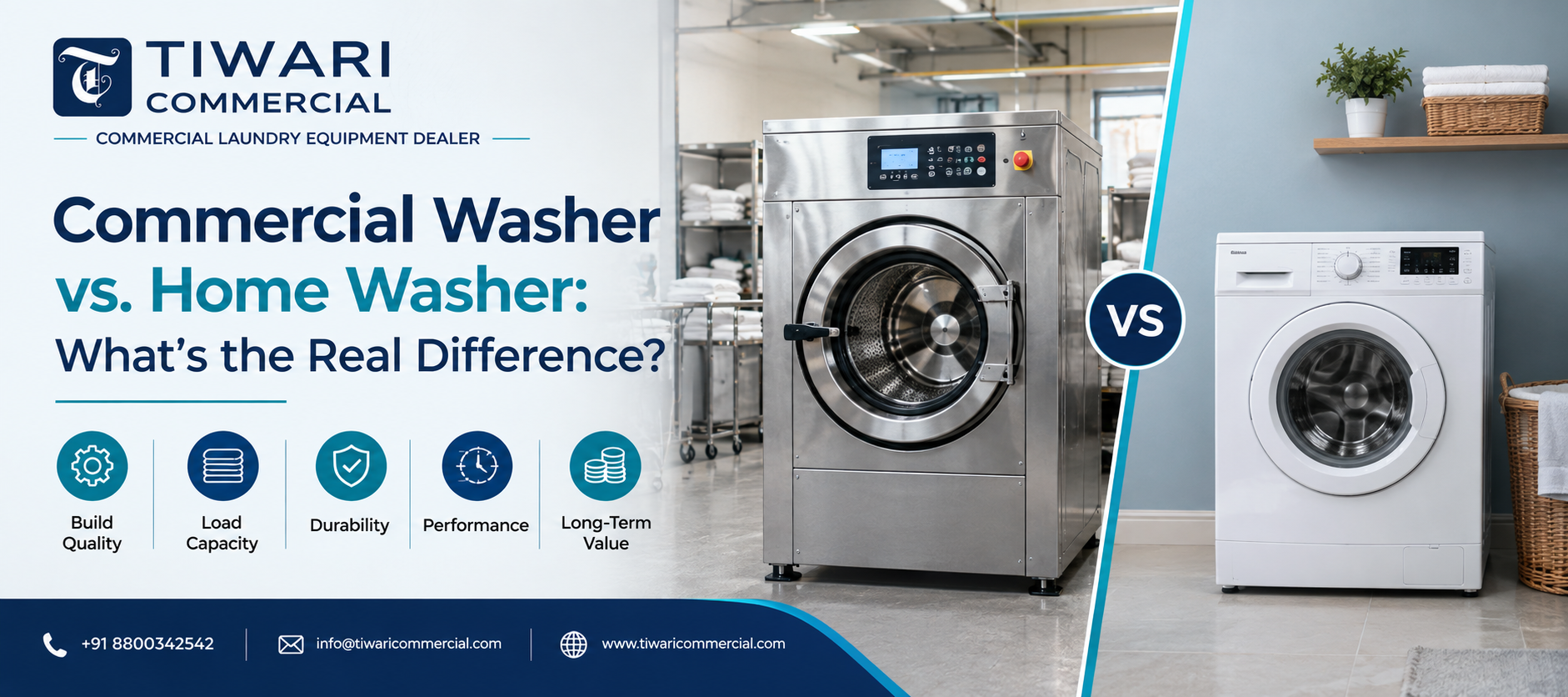
Commercial Washer vs. Home Washer: What's the Real Difference?
Walk into any laundry equipment showroom and you'll hear the same question from first-time buyers: "Why does a commercial washer cost five times what I'd pay for a good home machine when they both just wash clothes?" It's a fair question, and the honest answer is that they're not really the same category of machine wearing different price tags—they're built for fundamentally different jobs.
If you're evaluating equipment for a hotel, hospital, dry cleaning business, or commercial laundry, understanding this difference isn't academic. It's the decision that determines whether your laundry operation runs smoothly for the next decade or breaks down every few months under pressure it was never designed to handle.
Built for a Different Job Entirely
A home washer is engineered around a simple assumption: a few loads a week, spread across days, with rest time between cycles for the motor and drum to cool down. Everything about its construction — the bearings, the drum suspension, the motor sizing — is built around that lighter, intermittent duty cycle.
Commercial machines are engineered around the opposite assumption: back-to-back cycles, all day, every day, with no built-in recovery time. That single design difference cascades into nearly every other distinction between the two categories.
Lifespan: The Gap Is Bigger Than Most People Expect
This is usually where the price difference starts making sense. A typical residential washer is designed to last around 3,000 wash cycles under light home use. Commercial machines, by contrast, are engineered for 10,000 or more cycles, with some heavy-duty models tested well beyond that — a difference substantial enough that a well-built commercial washer can outlast several residential machines put through comparable use.
Put another way: a hotel running a residential machine at commercial volume isn't getting years of service from it — it's often getting months, because the equipment simply wasn't built for that duty cycle in the first place.
Cycle Speed and Water Extraction
Anyone who's used both will notice this immediately. Commercial washers typically complete a standard cycle in 25 to 45 minutes, compared to 60-90+ minutes on a residential machine running an equivalent load. This isn't just about impatience — for a business, faster cycles mean more loads processed per day from the same machine, which directly affects how much laundry a property can turn over without needing additional equipment.
The other major difference is extraction force. Commercial washer-extractors typically spin between 200 and 400 G-force during the final extraction phase, compared to 100-200 G-force on residential units. Higher extraction pulls significantly more water out of the load before it goes to the dryer, which shortens drying time and reduces energy consumption downstream — a detail that compounds into real savings when you're running dozens of loads daily.
Construction and Build Materials
Open up a commercial washer and a residential one side by side, and the difference in build quality is immediately visible. Commercial units use stainless steel drums, reinforced panels, and heavy-duty mechanical components designed to withstand constant use. Residential machines often rely on lighter materials and plastic components that are perfectly adequate for occasional home use, but not built to survive continuous commercial-grade operation.
Capacity: More Than Just a Bigger Drum
Commercial washers range widely in capacity — commonly anywhere from 10 kg on the smaller end up to 100+ kg for large-scale operations, compared to the 6-9 kg typical of most home machines. But the real implication isn't just "more clothes per load." It's that a correctly sized commercial machine processes your actual daily laundry volume in fewer total cycles, which matters enormously for a hotel or laundry business trying to manage water and electricity costs alongside staff time.
Why This Distinction Matters More As Your Business Scales
For a small guesthouse doing minimal in-house laundry, this gap might not justify the investment yet. But for any hotel, hospital, dry cleaner, or commercial laundry operating at meaningful daily volume, running residential equipment past its intended use case isn't a cost-saving decision — it's a deferred expense that shows up later as breakdowns, emergency repairs, and inconsistent linen quality during exactly the periods when a business can least afford the disruption.
This is precisely why working with an established commercial laundry equipment supplier matters at the equipment selection stage, rather than treating it as a simple purchase decision. The right supplier doesn't just sell you a machine — they help you match capacity, build quality, and features to your actual operational volume, so you're not overpaying for capacity you don't need or underbuying equipment that will fail under real demand.
What This Looks Like in Practice
At Tiwari Commercial Equipment, this is a conversation we have regularly with hotel owners, hospital facility managers, and commercial laundry operators across Delhi NCR. Our Washers page covers the range of commercial-grade options available, from mid-capacity models suited to smaller properties up to high-volume washer-extractors for large-scale operations. For hospitality-specific requirements — where guest linen quality and turnaround time are non-negotiable — our Hospitality solutions are built around exactly this kind of duty-cycle mismatch problem.
If you're running a commercial laundry or laundromat rather than an on-premise hotel operation, our Commercial Laundries page walks through equipment sized specifically for that business model, where daily volume and cost-per-load matter more than almost anything else.
The Bottom Line
The price gap between a commercial washer and a home washer isn't arbitrary — it reflects a genuinely different engineering standard built for a genuinely different job. A home washer handling a few loads a week and a commercial machine running dozens of cycles daily aren't the same category of equipment wearing different price tags; they're built to different specifications for different demands entirely.
If you're still weighing whether your specific volume justifies commercial-grade equipment, it's worth reading our related breakdown on what you actually get with a commercial washing machine under ₹1.5 lakh, which covers the realistic entry point for smaller operations. Or get in touch with our team directly for a consultation based on your actual daily laundry volume — that's usually the fastest way to know exactly which category of machine your business actually needs.